
EOA-130
New · preliminary specs
Miniature Ethernet-over-Air Adapter
The EOA-130 is a miniature 57 × 42 mm, 70 g COFDM Ethernet-over-Air module for UAV/USV FPV video, data and C2 links, delivering 50+ Mbps peak throughput and up to 40+ km with directional antennas in the dual-PA 2T2R configuration. Its optimized band spans 2230–2500 MHz (custom 100 MHz–6 GHz) with AES-128/AES-256 encryption. Dynamic channel switching — manual on-the-fly or automatic, signal-quality driven — keeps the link alive in contested spectrum.

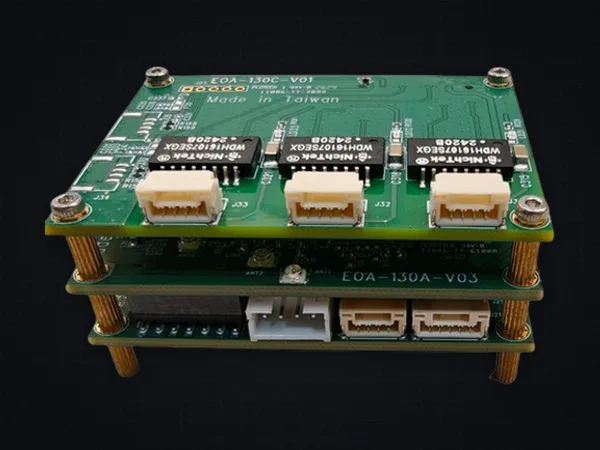
1/2
- Peak throughput
- 50+ Mbps
- Directional antennas + 2T2R
- 40+ km
- Board size
- 57×42 mm
- Bare board w/ cables
- 70 g
System features
- 01 Channel bandwidth 2.5 / 5 / 10 / 20 / 40 MHz
- 02 Dynamic channel switching: manual on-the-fly or automatic
- 03 Optional split up/down frequencies vs directional jamming
- 04 P2P / P2MP / Mesh topologies
- 05 Transparent Ethernet and UART/S.BUS links
- 06 AES-128 / AES-256 encryption
[ Why EOA-130 ]
Reach where microwave can’t
The EOA-130 uses COFDM transmit and receive to carry reliable long-range broadband over terrain and non-line-of-sight paths — for UAV and USV FPV video, telemetry and command and control (C2), or for extending a network into the field.
- 01
Long range
Up to 40+ km with directional antennas and the dual-PA configuration.
- 02
Any terrain
Gets through obstacles and non-line-of-sight paths that defeat traditional microwave links.
- 03
Jam-resistant
Custom and non-ISM bands can be configured to step around interference and jammers.
- 04
Drop-in ready
Transparent Ethernet plus UART/S.BUS — plug in with no protocol changes.
[ Range ]
The second amplifier adds a third more range
At every antenna, the dual-PA 2T2R board reaches about a third further than the single-PA board: 6 → 8 km on a 5 dBi omni, 15 → 20 km on a 14 dBi patch, 30+ → 40+ km on a 21 dBi dish with tracking.
1 W PA
- 5 dBi omni
- 6 km
- 14 dBi patch
- 15 km
- 21 dBi dish + tracking
- 30+ km
1 W PA ×2 (2T2R)
- 5 dBi omni
- 8 km
- 14 dBi patch
- 20 km
- 21 dBi dish + tracking
- 40+ km
[ Anti-jamming ]
Built to keep the link up in contested spectrum
Three mechanisms, used together: move the link across a wide tunable range, switch channels without dropping it, and — optionally — split transmit and receive onto separate bands.
-
Wide tunable frequency range
Relocate the link across a broad band to step away from crowded or jammed spectrum.
-
Dynamic channel switching
Change the operating channel without tearing down the link.
- Manualon the fly
- Automaticsignal-quality driven
-
Separate up / down frequencies Optional
Independent TX and RX bands add robustness against directional, reactive jamming.
[ Topologies ]
One link to a swarm, on the same hardware
The same EOA-130 runs as a point-to-point link, as a star with one ground node commanding several aircraft, or as a self-healing mesh.
Ground
Aircraft
Aircraft
Ground
- Radio link, two-way
- Ethernet
- UART
Redrawn from the EOA-130 preliminary datasheet, p2.
Point-to-point P2P
A dedicated full-rate link between a ground station and a single platform.
Characteristics
- Ethernet and UART both cross the link transparently, with no protocol changes at either end.
- On the aircraft, the flight controller connects on UART and the gimbal camera on Ethernet.
- On the ground, the controller connects the same two ways.
- Radio link, point-to-multipoint
Redrawn from the EOA-130 preliminary datasheet, p3.
Point-to-multipoint P2MP · 1-to-N
Star topology: one master ground node commanding multiple UAV nodes.
Characteristics
- Centralized: one master node, the ground station.
- Multiple slave nodes, one per aircraft.
- All traffic goes through the master.
- The master handles command and control, mission planning, telemetry monitoring and data collection.
- Mesh radio link, multi-hop
Redrawn from the EOA-130 preliminary datasheet, p3.
Mesh network Self-organizing
Decentralized, self-healing multi-hop mesh with no single point of failure.
Take a node out and watch it reroute ↓Characteristics
- Decentralized, with no single point of failure.
- Self-healing: traffic reroutes automatically when a link fails.
- Multi-hop: other aircraft relay traffic beyond the reach of a direct link.
- Scalable: more aircraft can join the network.
[ Self-healing ]
If the straight line is blocked, it takes another hop
The mesh is decentralized and multi-hop, with no single point of failure. When two ends are too far apart, or terrain blocks line of sight, the link does not have to be a straight line — traffic reaches the far end by way of other aircraft. It is self-organizing and self-healing: take any node offline and the rest converge on a new route.
[ Applications ]
One link platform — air, sea and ground
The EOA-130 carries the same transparent Ethernet across airborne, maritime and ground work.
-
UAV FPV & video
HD first-person video and telemetry for fixed-wing and multirotor aircraft.
-
USV & maritime
Resilient over-water links for unmanned surface vehicles.
-
C2 datalink
Two-way command and control with transparent S.BUS / UART.
-
Drone swarms
Mesh-connected multi-UAV operations with self-healing routing.
-
Rural backhaul
Broadband Ethernet extended into terrain that microwave can’t serve.
From the EOA-130 promotion brochure.
EOA-130
Specifications
Model options
-
EOA-130-2200A
Single PA · 1 W
- Optimized band 2230–2500 MHz
- Built-in 1 W PA (30 dBm)
- Compact, lightweight field link
- Up to ~30+ km
-
EOA-130-2200B
Dual PA · 2T2R
- Optimized band 2230–2500 MHz
- 1 W PA (30 dBm) ×2 — 2T2R
- Diversity for robustness and range
- Up to ~40+ km
-
EOA-130-Custom
Mission-tailored
- 100 MHz–6 GHz, including non-ISM bands
- Power amplifier 1–30 W
- Custom bands to avoid jammers
- Designed to requirement
HiDes can develop custom designs for additional frequency bands and power levels on request.
RF parameters (preliminary)
- Frequency (1 kHz step)
- 2230–2500 MHz · custom 100 MHz–6 GHz
- Bandwidth
- 2.5 / 5 / 10 / 20 / 40 MHz
- Constellation
- BPSK / QPSK / 16QAM / 64QAM
- Code rate
- 1/2 · 2/3 · 3/4 · 5/6
- Output power
- 30 dBm (1 W) ×1 / ×2 (2T2R)
System (preliminary)
- Data rate
- Up to 50+ Mbps
- Connectors
- IPEX & SMA 50 Ω · RJ-45 · UART
- Power
-
- Input DC 9–35 V
- Tx 2T2R 0.9 A
- Tx 1T2R 0.5 A
- Rx 0.14 A
Currents at 12 V, 5 MHz bandwidth
- Dimensions / weight
- 57 × 42 mm × 2 boards · 70 g
- Operating temp.
- −10 °C ~ 70 °C
Range (estimated)
- 5 dBi omni
- 6 km (1 W) · 8 km (2T2R)
- 14 dBi patch
- 15 km (1 W) · 20 km (2T2R)
- 21 dBi dish + tracking
- 30+ km (1 W) · 40+ km (2T2R)
※ Specifications are the June 2026 preliminary release; production specs subject to the final document.
https://hides.com.tw/en/products/eoa-130/ · +886-2-2917-2417 · info@hides.com.tw